
Boost Roofing Jobs with AI Voice Agents in 2026
Roofing, AI Voice Technology, Lead Conversion
How AI Voice Agents Help Roofing Companies Book More Jobs in 2026
In a market where every inbound call could be a five-figure roof replacement, missing prospects is no longer acceptable. AI voice agents are giving roofing companies across North America a powerful new way to capture, qualify, and book more jobs—automatically, 24/7, without adding headcount.

What Exactly Is an AI Voice Agent for Roofing?
An AI voice agent for roofing is a conversational phone system powered by advanced speech recognition and natural language processing. Instead of a simple voicemail or a basic call center script, it behaves like a trained office coordinator who understands roofing terminology, asks the right questions, and books appointments directly into your calendar or CRM.
Thanks to low-latency, speech-to-speech AI models that have matured by 2026, these agents respond in under a second, creating a natural, human-like conversation that homeowners are comfortable with. Industry reports show conversational AI has moved from pilot projects to full production across service businesses, giving contractors reliable tools for dispatch and lead handling (Famulor, 2026 State of Voice AI Report).
How AI Voice Agents Work for Roofing Businesses Specifically
General-purpose voice assistants are not enough for contractors. A modern AI phone agent roofing solution is trained on the realities of your business: storm damage surges, emergency leaks, insurance questions, and seasonal spikes in inspection requests. Drawing on the same AI advances transforming construction and roofing—from predictive analytics to connected jobsite data (ForConstructionPros; RoofingContractor)—these agents plug into your existing systems and workflows.
- Service-aware conversations: The agent understands terms like tear-off, re-roof, metal vs. shingle, flat vs. steep-slope, and can guide callers to the right service category without confusion.
- Real-time scheduling: Using roofing company automation, it checks your team’s availability and books inspections or repairs on the spot—no phone tag, no back-and-forth texts.
- Integrated data capture: Every call is logged with contact details, job type, urgency, and notes, feeding your CRM and marketing systems for future follow-up and upsell opportunities.
In short, AI booking for roofers turns your phone line into a smart, always-on sales and scheduling engine that understands the roofing trade—not just generic customer service scripts.
Never Lose a Lead Again: Handling Missed Calls and Qualification
For most roofing companies, the biggest leak in the sales funnel isn’t marketing—it’s missed calls. Crews are on the roof, office staff are overwhelmed, and storms don’t wait for business hours. That’s where a 24/7 answering service roofing powered by AI becomes a game changer.
- Instant pickup: The AI answers every call on the first or second ring, day or night, weekday or weekend, giving homeowners immediate reassurance that help is on the way.
- Smart triage: It distinguishes between emergencies (active leaks, storm damage) and non-urgent inquiries (maintenance, estimates) and routes or books them appropriately.
- Lead qualification: Through structured questions—property type, roof age, material, insurance involvement, budget sensitivity—it quickly qualifies the opportunity and tags it as high, medium, or low value for your team.
This level of roofing lead conversion automation is already common in other trades and is rapidly spreading to roofing as AI adoption accelerates among contractors (SmallBizTrends, 2026). When your competitors are still sending callers to voicemail, your AI agent is turning those same calls into scheduled inspections.
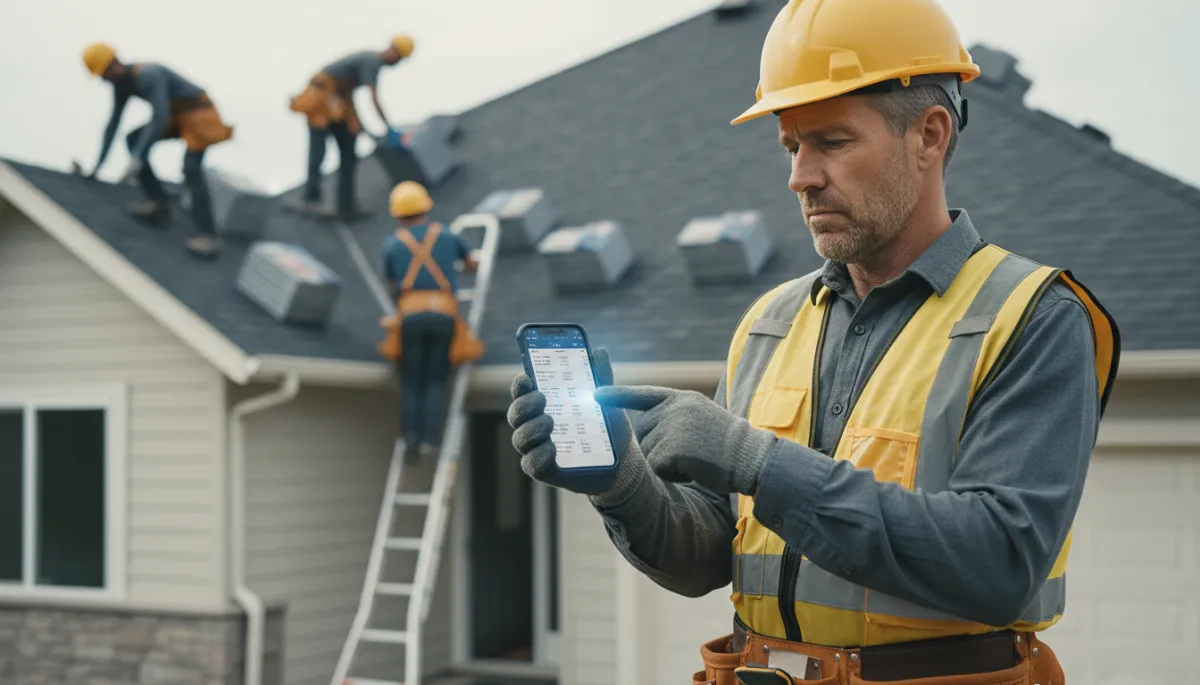
AI-scheduled inspections keep crews booked solid while owners stay focused on operations.
The ROI: More Booked Jobs, Less Overhead, and Faster Response
Roofing is a high-ticket, low-margin business. Small changes in conversion and efficiency have an outsized impact on profit. A well-implemented voice AI for contractors delivers ROI on multiple fronts:
- Higher conversion from existing leads: Industry data shows that answering calls within a minute can double conversion rates compared to callbacks hours later. AI ensures you always respond instantly, improving roofing lead conversion without increasing ad spend.
- Lower staffing costs: Instead of hiring additional office staff or paying a premium for overnight answering services, AI handles the bulk of routine conversations, letting your human team focus on complex questions and closing high-value deals.
- Fewer wasted appointments: Because the AI pre-qualifies leads, your estimators spend more time on jobs that are likely to close—homeowners with decision-making authority, appropriate budgets, and real intent to move forward.
When you combine better conversion, lower overhead, and smarter scheduling, the payback period for AI booking for roofers is often measured in weeks, not years—especially in markets prone to hail, hurricanes, or heavy seasonal storms where call volume spikes dramatically.
AI vs. Traditional Answering Services: What’s the Difference?
Many roofing companies already use call centers or basic answering services. But compared to a modern AI phone agent roofing solution, those options are starting to look outdated and expensive.
- Consistency vs. variability: Human agents vary in quality, training, and mood. AI delivers the same professional, brand-aligned experience on every call, with scripts optimized over time based on performance data.
- Deep integration vs. message taking: Traditional services usually just collect a name and number. AI integrates with your CRM, calendar, and even estimating tools, turning calls directly into booked visits and pre-filled job files.
- Scalability vs. capacity limits: During a storm event, hundreds of calls can hit at once. Human call centers buckle under that load; AI effortlessly scales to handle every caller simultaneously without sacrificing quality.
In a construction environment where voice technology is rapidly evolving—from AI-controlled equipment to ambient data capture on job sites (Procore, 2026 Construction Tech Trends)—it no longer makes sense to rely on outdated phone systems at the front door of your business.
Why Forward-Thinking Roofing Owners Are Moving Now
Reports show a trust gap among many residential contractors when it comes to AI, with only about a quarter using it meaningfully today (RepuClinic, 2026). For roofing leaders, that hesitation is an opportunity. Early adopters of roofing company automation are already:
- Capturing more of the inbound demand generated by their existing marketing.
- Delivering faster, more professional responses than competitors still relying on voicemail.
- Building rich call data that informs pricing, staffing, and geographic expansion decisions.
In other words, they are using voice AI for contractors not just as a cost-saving tool, but as a competitive weapon in crowded roofing markets.
Ready to Turn Your Phone Line into a Sales Engine?
If you are a roofing company owner or operator in North America, the question is no longer whether AI will impact your business—it already is. The real question is whether those benefits will flow to you or to your competitors. An AI voice agent for roofing gives you a practical, immediately measurable way to step into the future: more booked inspections, fewer missed opportunities, and a smoother experience for every homeowner who calls your number.
Imagine your next storm season with a 24/7 answering service roofing solution that never sleeps, never puts callers on hold, and never forgets to ask the qualifying questions that matter. That is what modern AI phone agent roofing technology delivers today—not five years from now.
Take the next step now: evaluate an AI-powered call solution built specifically for roofers, connect it to your scheduling tools, and run it alongside your current process for 30 days. Track how many additional inspections you book, how many after-hours emergencies you capture, and how your close rate changes. The numbers will speak for themselves—and your phone line will finally work as hard as your crews do.
